RoboDuck
A small biped robot. We start from Pollen Robotics' Microduck and the Open Duck Mini project, both Apache-2.0 for code, and change what we can measure and improve.
How it learns
Clips Simulation
Stage C
Backlash 1.5°, 0.3 m/s command. Stress eval 87.5% tracking at 214.6M steps (gate: 90%). Did not pass.
microduck/results.tsv:84
Stage D
Backlash 1.5°, 0.3 m/s command. Stress eval 81.4–83.4% across two checkpoints, 0 falls. Did not pass.
microduck/results.tsv:89-90
Stage E
Backlash 1.5°, 0.3 m/s command. Stress eval 85.0% (64M) and 92.1% (107M), but the 107M checkpoint lost turning. Did not pass.
microduck/results.tsv:92
Where it started
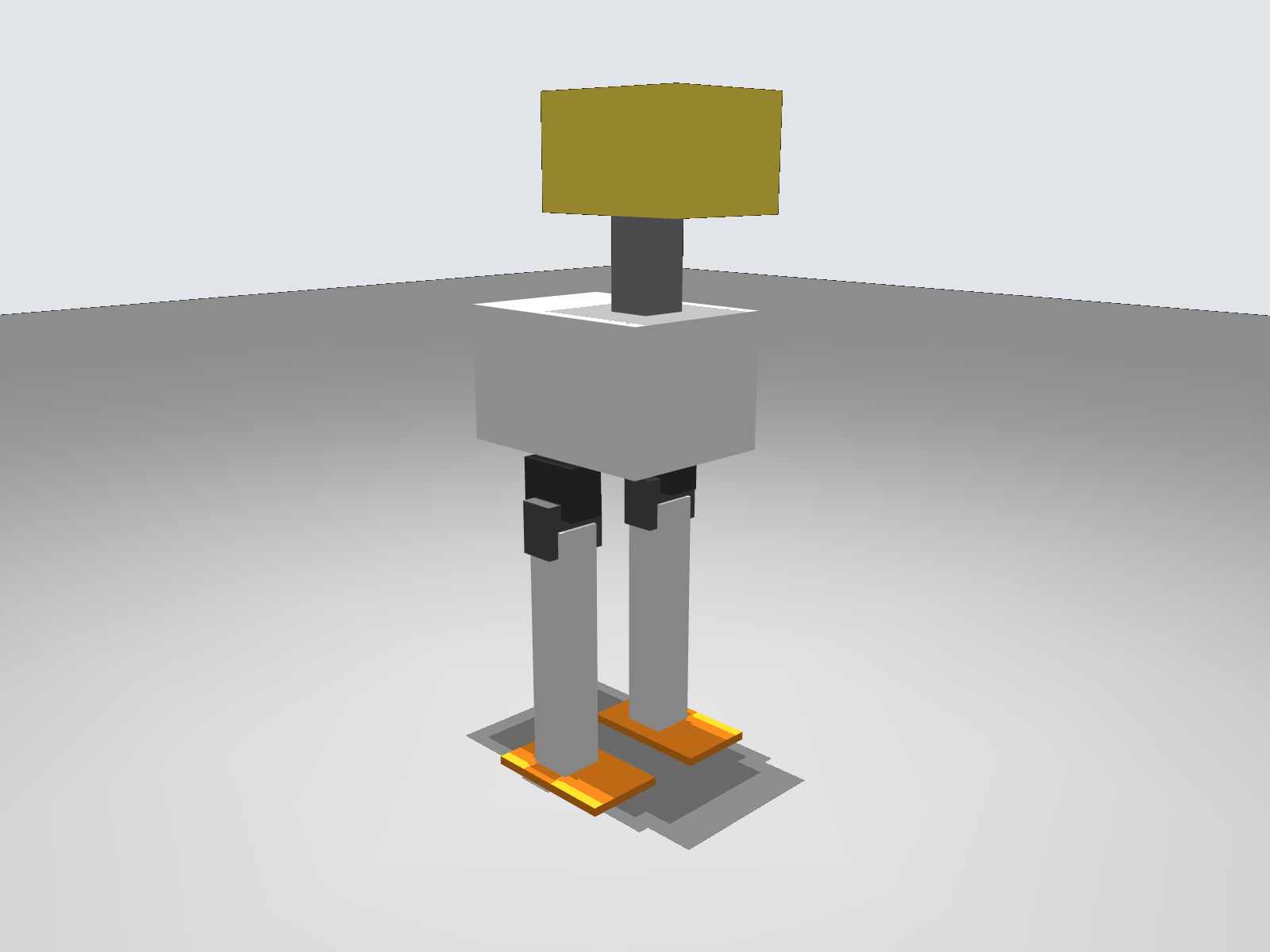
Pollen's Microduck: 25 cm, 800 g, 15 motors, camera, LiDAR and two IMUs, with a 50 Hz onboard policy trained in MuJoCo. Microduck's STL meshes are CC BY-NC-SA 4.0 (non-commercial), so RoboDuck needs its own geometry for anything sold.
Results so far Simulation
| Date | Run | Setting | Result |
|---|---|---|---|
| 2026-10-22 | Earlier Open Duck Mini walk policy (before Stage B), robustness | Nominal randomization, commands 0.1 / 0.2 / 0.3 m/s, 15 trials each | Velocity tracking 95% / 95% / 67%, 0 falls |
| 2026-10-23 | Stage B policy eval | Nominal, commands 0.2 / 0.3 / 0.4 m/s, 10 trials | Measured 0.192 / 0.259 / 0.293 m/s, 0 falls |
| 2026-10-23 | Stage B policy eval | Stress set, same commands | 0.147 / 0.210 / 0.224 m/s, 0 falls |
| 2026-10-23 | Slow walk, 0.1 m/s | Command floor 0.12, 3 seeds × 10 runs | Tracking 101.5% ± 2.1, 0 falls, 3/3 seeds pass |
What's next
Next policy gate: at least 85% velocity tracking at 0.3 m/s under 1.0–1.5° backlash, 3 seeds × 10 runs, zero falls, no loss of turning. Then a second simulator (Isaac Lab) for cross-checks, our own parametric CAD, and an open BOM.
Credit: pollen-robotics/microduck and Open_Duck_Mini, Apache-2.0.